

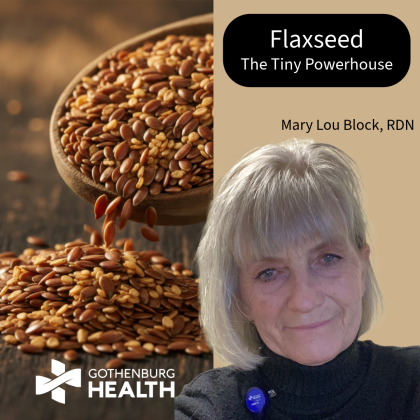
The Tiny Powerhouse Seed
Want some Linum usitatissimum, or more simply put, some flaxseed in your smoothie? Flaxseed may be a simpler name, but the many actions and benefits of flaxseed are anything but simple.
Flax has a long history of cultivation in the northern hemisphere for its fiber and oil content. But it has recently enjoyed popularity as a health food. You will see it marketed as seed, ground meal and cold pressed flax oil (FO), also known as linseed oil. But don’t confuse food grade linseed oil with non-edible linseed oil used in paints! The extraction process is different, producing health food on one hand and a paint additive on the other.
Health food claims start with the nutrition label. One tablespoon of flax boasts of an impressive 2 g of plant-based protein, 4 g of fat (mostly omega 3) and 3 g of carbohydrate, 2.8 g, coming from fiber. It is the high fiber content that earns it the award-winning designation of “zero net-carb”.
Besides an impressive food label, other flax components move it into the category of a functional food with health benefits. These health components of flax are concentrated in a three-legged nutrient stool of omega-3, fiber, and lignan.
Next month we will examine omega 3 and fiber in more detail as they relate to metabolic health and Type 2 Diabetes. For now, we will concentrate on lignan.
Lignan
Lignans are bioactive compounds called phytochemicals. They are not considered essential for humans but exhibit biological activity with health benefits.
Flaxseed happens to be one of the richest dietary sources of lignans. In fact, the lignan content of flax is 100x more abundant in this tiny seed than in any other of the lignan-containing grains, fruits or vegetables.
Flax lignan, Secoisolariciresinol diglucoside (SDG) is a lignan precursor. Like the polyphenols we discussed last month, SDG traverses the GI tract, undigested and unabsorbed, until it reaches the colon. There, the gut microbes convert it to several phytoestrogens, enterodiol (END) and enterolactone (ENL). These interact with estrogen receptors throughout the body, bringing benefits of hormonal balance (think menopause, NOT pregnancy/lactation), antioxidant activity, cardiovascular and bone health.
Since this is Breast Cancer Awareness Month, it is also of interest to note that lignans can interact with cancer pathways, specifically hormone-related breast cancer pathways. In one clinical trial, 50 mg of lignans for 32 days reduced this type of tumor growth, while 50 mg/day for one year reduced breast cancer risk in premenopausal women. This, of course, is not a cure claim, but an area of that needs further research. Other studies also show that lignans may be effective in colon and metastatic cancers.
At the very least, dietary flax seed or high-lignan flaxseed oil is a hopeful protocol-add for people battling such difficulties. But always check with your provider about your situation before making an add.
Have I piqued your interest in this tiny powerhouse seed? Stay tuned next month for more information and recipes!